
Plastic surgeons rank in the Google Map Pack by aligning three signals: relevance, distance, and prominence. You improve those signals with an accurate Google Business Profile, consistent location data, strong local pages, legitimate reviews, and local authority. Then you connect that visibility to calls, consultations, acquired patients, and revenue.
You will learn:
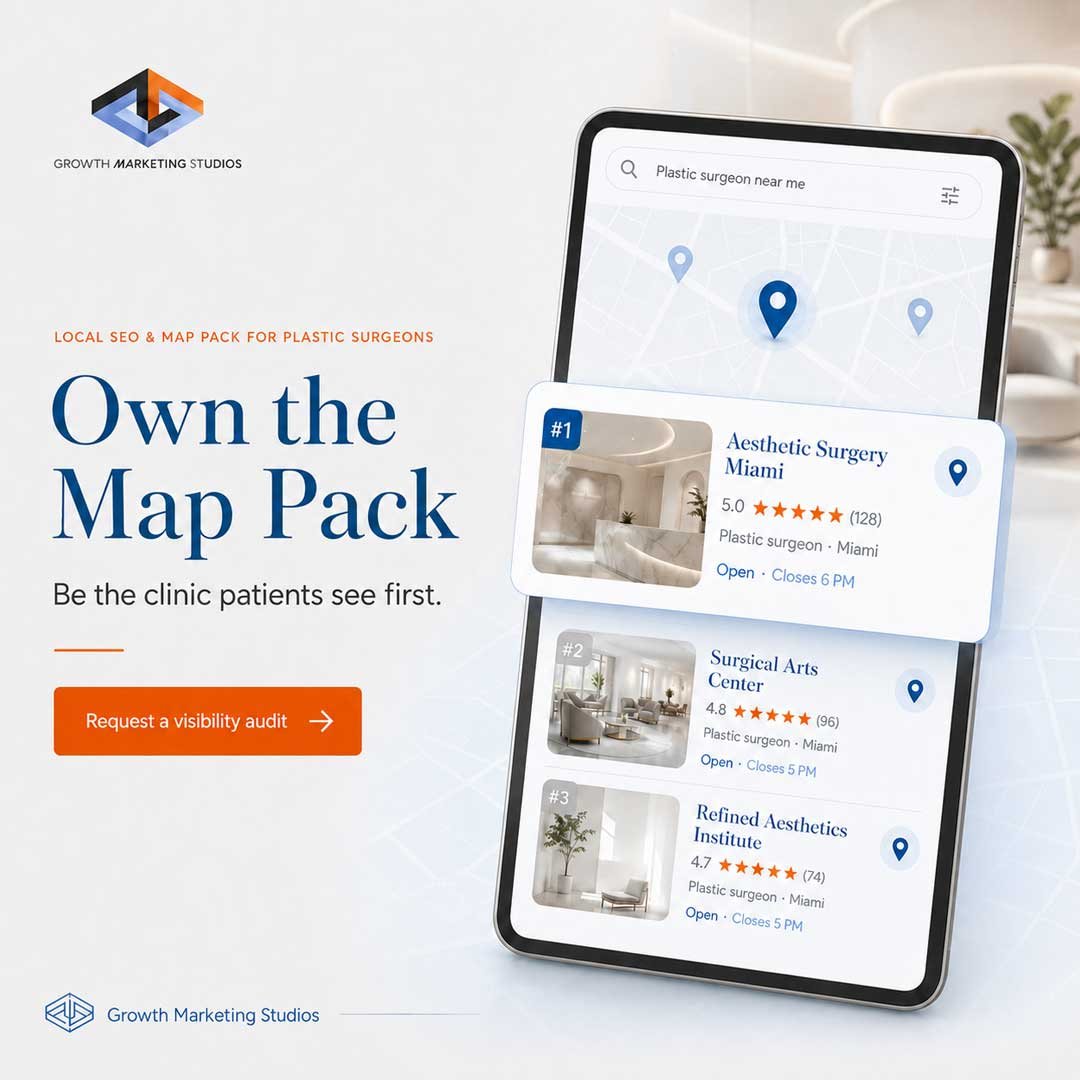
The Google Map Pack displays local businesses that Google considers relevant to a searcher’s query and location. For a term such as “plastic surgeon near me,” your position can change according to where the search starts, what the patient types, and the strength of nearby competitors.
Google states that local results are based mainly on relevance, distance, and prominence. Relevance measures how closely your practice matches the query. Distance measures how far the practice is from the searcher. Prominence reflects how established the business appears through reviews, links, directories, and other online signals. You can improve relevance and prominence. You cannot control where every potential patient is standing when they search.
A plastic surgery practice does not have one permanent Google Maps position. It has a visibility footprint. Your practice might rank in the top three close to the office, fall below the Map Pack five miles away, and disappear in another ZIP code. That is why checking a single search from your desk produces incomplete data. You need a local ranking grid that runs the same query from multiple coordinates. The grid shows where your practice is visible, where competitors control the results, and where your location signals weaken. You can then compare that data with calls, website visits, consultations, and acquired patients. The goal is not to be visible everywhere. The goal is to appear where qualified patients search and to give them enough evidence to contact your practice.

We have managed plastic surgery accounts that moved from page-five visibility to first-page positions for major sector keywords between 2023 and late 2025. That progress did not come from one profile edit. It came from aligning the business entity, website, location, reviews, and authority signals.
Local search is one part of a broader plastic surgery SEO strategy, but it requires its own workflow. Your team must manage profiles, directories, reviews, local landing pages, and location-based reporting.
Start with accurate business information and the most specific primary category that describes the practice. Then complete the services, hours, appointment information, website destination, business description, and visual assets.
Google says businesses with complete and accurate information are more likely to appear for relevant local searches. The platform also advises businesses to maintain current hours, verify the profile, respond to reviews, and publish useful photos and videos.
Your optimization checklist should include:
Do not add keywords to the practice name unless they are part of the real-world business name. Do not create fake locations to reach surrounding cities. Do not treat Google Business Profile posts as a replacement for accurate categories, services, and location information.

Your Google Business Profile should answer five questions before a prospective patient visits your website. Who are you? Where are you located? What services do you provide? Why should the patient trust the practice? What is the next step? Categories and services help Google understand the entity. The address and local phone number establish location. Photos show that the practice exists and help patients evaluate the environment. Reviews provide third-party evidence. The appointment and website links create a path to conversion. Every field should describe the same practice that appears on your website and medical directory profiles. Conflicting names, addresses, phone numbers, or service descriptions create friction for search engines and patients. A profile is not a form you complete once. It is an operating asset that needs ownership, review, and maintenance.
In our work with Zion Plastic Surgery, the local profile was part of a connected system that included the clinic website and structured search visibility. The documented Search Console period recorded 4,460 clicks, 41,500 impressions, a 10.7% click-through rate, and an average position of 4.9.
The lesson is practical. Your Google Business Profile cannot compensate for a weak website, inconsistent location information, or poor conversion paths.

You can request honest reviews through a consistent process, but your team must protect privacy when it responds. Never use a public reply to confirm that the reviewer received treatment, visited the office, discussed a procedure, or had a clinical outcome.
Reviews influence local decisions. BrightLocal’s 2026 survey of 1,002 US adults found that 97% read reviews for local businesses. The same study found that 85% were more likely to use a business after reading positive reviews.
Build a repeatable request workflow:
The review itself does not give your practice permission to reveal additional information.
A privacy-conscious review response should acknowledge the feedback without confirming a clinical relationship. Do not mention a procedure, appointment date, diagnosis, payment, insurance issue, medical record, or conversation with staff. A positive response can say, “Thank you for taking the time to share your feedback. We appreciate your comments.” A negative response can say, “We take feedback seriously. To protect everyone’s privacy, we cannot discuss individual circumstances here. Please contact our office manager so the matter can be reviewed privately.” The response does not debate facts in public. It moves the conversation to a controlled channel. Your practice should document an approved response process and have legal or compliance counsel review it. Privacy must remain part of your broader HIPAA approach to plastic surgery marketing.
This risk is documented. The HHS Office for Civil Rights reached a $23,000 settlement with a dental practice after protected health information was disclosed in responses to online reviews.
A negative review can hurt. A privacy violation can create a larger problem. Your response should protect the practice even when the reviewer has already shared personal details.
Your profile is only one source of information about the practice. Google can also evaluate your website, directory listings, reviews, local mentions, and links when determining local prominence.
Your name, address, and phone number should match across the website, Google Business Profile, medical directories, local listings, and professional profiles.
Prioritize listings that patients or search engines can reasonably trust. These can include medical directories, hospital affiliation pages, state associations, chambers of commerce, and established local business platforms.
Do not chase hundreds of low-quality listings. Start by correcting inaccurate records, duplicate profiles, old phone numbers, and former addresses.

Every legitimate patient-facing location should have a page that explains:
A useful location page explains why the practice belongs in that market. A thin city page replaces one city name with another and provides no local evidence.
For a multi-location group, each eligible office needs distinct information. Do not send every profile to a generic homepage when a relevant location page exists.
Local links can come from:
In the documented Dolls Plastic Surgery case study, the SEMrush Authority Score increased from 6 to 31. The backlink profile grew from 76 links to approximately 10,600 during the measured growth period.
Those numbers did not replace local relevance or proximity. They strengthened the practice’s broader prominence.
Choosing a plastic surgeon SEO company becomes an operational decision when your internal team cannot maintain profiles, listings, content, reviews, tracking, and local authority consistently. An effective SEO service for surgeons should connect each of those activities to qualified patient acquisition.

Measure Local SEO from visibility to acquired patients. A top-three position has limited business value when it does not produce calls, consultations, or deposits.
Start with a local rank grid. Run the same high-intent query from multiple coordinates around each office. Track changes by keyword, radius, competitor, and date.
Then review Google Business Profile Performance. Google currently provides profile data such as searches, views, calls, website clicks, and direction requests when those metrics apply to the business.
Your reporting chain should be:
Map Pack visibility
Where the practice appears in local results, measured from a rank grid instead of a single search
Profile interaction
Searches, views, calls, website clicks, and direction requests recorded by Google Business Profile
Call or website visit
Tracked calls and website sessions that started from local visibility
Lead
Form submissions and calls identified through call tracking and form attribution
Consultation
Booked consultations recorded in the practice management system or CRM
Acquired patient
Patients measured through deposits, not raw inquiry volume
Estimated revenue
Deposits connected to known patient value, reported with its assumptions
Local SEO reporting should separate visibility from business performance. Grid rankings show where the practice appears. Business Profile data shows how people interact with the listing. Analytics shows what happens after a website visit. Call tracking and form attribution identify leads. The practice management or CRM system shows consultations, deposits, and acquired patients. Review these layers together. A ranking increase with no change in qualified calls may indicate weak conversion assets or poor query selection. More calls with no increase in deposits may indicate a lead quality or sales process problem. Revenue attribution will never be perfect, but the reporting system should help you decide what to improve next. You are not collecting metrics to decorate a report. You are using them to control patient acquisition.
The Dolls account shows why that connection matters. Client data for 2024 recorded:
The broader organic program also grew annual organic sessions from 22,000 in 2021 to 181,000 in 2024. Active users increased from 128,000 to 369,000 during the same period.
These figures should not be attributed to Google Maps alone. They demonstrate what becomes measurable when local visibility supports a wider acquisition system.

How long can your practice afford to operate with a low patient acquisition rate while competitors capture the highest-intent local searches?

You do not win Local SEO by completing a profile and waiting. You win by creating a consistent representation of the practice across Google, your website, medical directories, reviews, and local authority sources.
We have seen clinics move from page-five visibility to first-page positions. We have also seen why rankings alone are not enough. The system must connect local searches to consultations, acquired patients, and revenue.
Start with accuracy. Build evidence. Protect patient privacy. Track visibility from multiple locations. Then follow every qualified interaction as far into the acquisition process as your data allows.
Your practice does not need another report filled with impressions. It needs a predictable path from local demand to acquired patients.
There is no fixed timeline. Results depend on the practice location, competition, profile history, website quality, reviews, citations, and local authority. Track progress through ranking grids and patient acquisition data rather than waiting for one universal deadline.
Choose the most specific current category that accurately describes the primary business. Review the categories available inside Google Business Profile and avoid selecting unrelated categories simply to reach more searches.
Yes, a practice can request voluntary and honest feedback. The process should be consistent, should not pressure the patient, and should not require a positive review. Your legal or compliance team should review the workflow.
It can respond, but the reply should not confirm that the reviewer is a patient or disclose information about care, payment, appointments, or conversations. Use a neutral response and move the discussion to a private channel.
Each legitimate location should be evaluated under Google’s current eligibility rules. An eligible profile should use accurate office information and point to a relevant location page rather than a generic or unrelated destination.
Use a geographic rank grid that checks the same query from multiple coordinates. Compare the grid with profile interactions, website conversions, calls, consultations, deposits, and acquired patients.
This page is part of our 2026 Practice Growth Program. To guarantee ROI and consistent lead quality, we partner with just 5 new clients each year.
Our Plastic Surgery SEO program blends E-E-A-T-driven content, intentional authority, and smart keyword positioning to fill your calendar and your OR. We optimize your procedure pages, fine-tune your Google Business Profile to drive real calls, and lift conversion with before-and-after galleries, credible reviews, and HIPAA-friendly forms—measured end to end in GA4/GSC and orchestrated in GoHighLevel so every click has a next step. Most clinics see clear movement within 6–12 weeks and compounding growth when the cadence is maintained. Proof? Dolls Plastic Surgery scaled from 2,352 to 7,772 yearly bookings and generated $5.58M in deposits from 2021–2025. Tell us your market and priority procedures, and we’ll map a focused 90-day plan with clear actions and realistic targets. Share a few details below and let’s get started.
Message us
support@growthmarketingstudios.com